
Centrally Planned Infrastructure
Energy Safety
& Fire Safety for Buildings
At apartment buildings, a charging station is not a minor amenity, but
high-risk infrastructure - the threat of fire and explosion looms
Unregulated charging = higher risk of overload, short-circuit fire, and dragging the management board into the “liability zone.”
EVsafe deploys according to the model Dynamic Load Management (Load
Balancing):
the system automatically regulates the charging current based on the building's load - reducing the risk of blackout and thermal incidents.
Documents & deployment commitment (for the management board to submit for signing)
Transparency - traceability - reconciliationLoad survey record
Assess spare capacity, overload risk,
recommend a solution.
Diagram
power supply diagram (SLD)
Single-line diagram & zone partitioning
deployment.
protective-device checklist
Protection against leakage / overload / overheating
according to the project configuration.
Handling SLA
incident: 4h
Monitoring + alerting + response coordination
following the process.
* The level of documentation depends on the building's scale and current condition. EVsafe does not provide DIY guidance.
Get the sample management-board dossier
Schedule a survey
Responsibility allocation
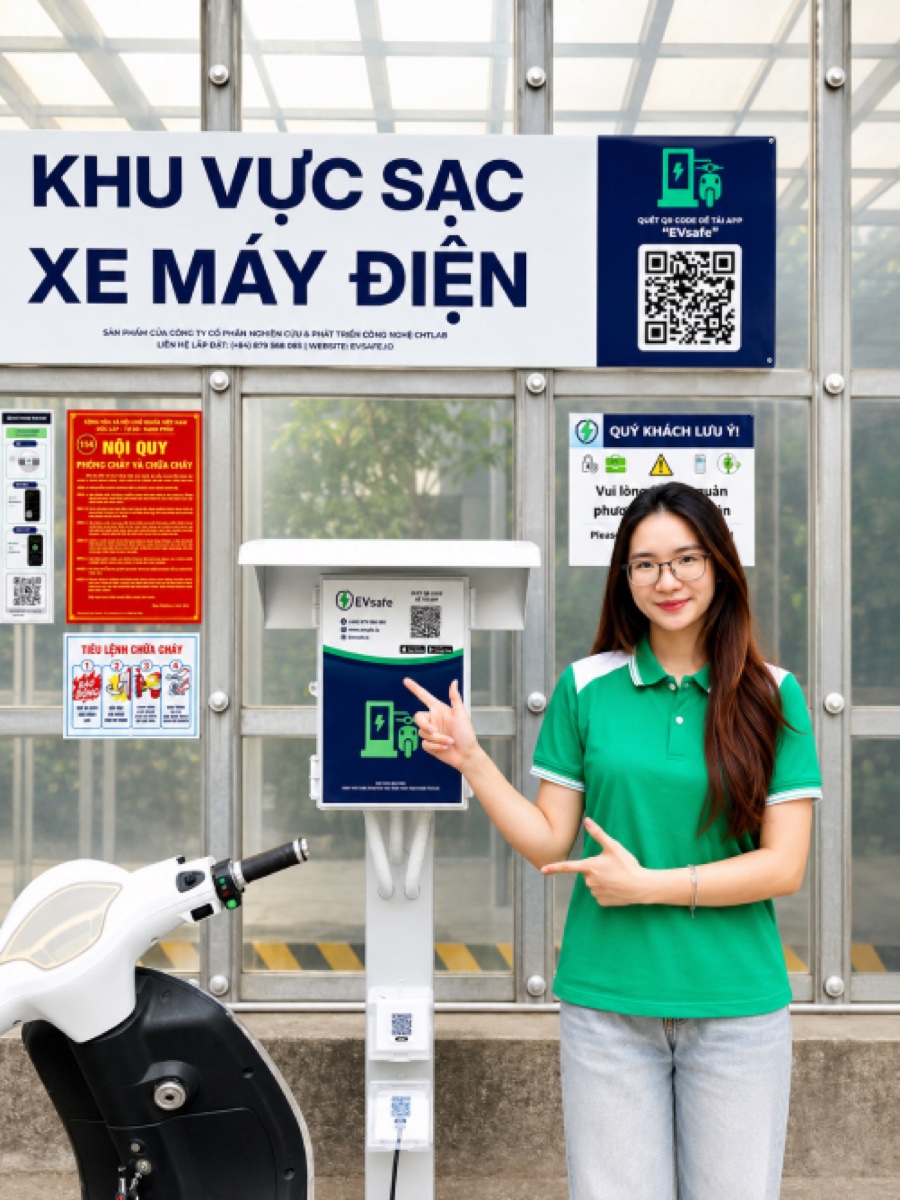
Building security alert
Improvised Charging:
“Ticking BombSlow” in the Basement
Apartment buildings are a risk-upon-risk environment: high density, emergency exits, floor-level electrical systems.
Letting residents wire it up themselves = accepting the risk of a chain-reaction incident.
Fire risk (Fire Hazard)
Household wiring + sockets not designed for prolonged charging. Accumulated heat causes over
heat, short-circuit fires in the basement/floor electrical cabinet area.
Loss of power control
Not knowing who is charging how much → easy to trip the breaker, power outages at peak hours, affecting
the entire building.
Legal liability
When an incident occurs, the management board/management unit is the first to be named. So “planning + operation +
documentation” is the lifeline.
Planning solution
Which model does EVsafe recommend?
Choose the model based on resident demand + current load + site. Prioritize “safety & traceability”.
Electric motorbike charging zone (E-Bike)
The main demand (usually 70-90%). Dedicated zone planning + load management + trac
traceable by user.
Electric car charging zone (AC Charging)
Conditional deployment: 3-phase load survey + load balancing to avoid “over
domino” of power across the whole building.
Mixed station (Visitor)
Optimized for commercial areas/shophouses: separating resident vs guest flows, per regulations
building operation.
Transparent cooperation
Who is accountable
safety & legal?
The key for the management board to “dare to deploy”: clear responsibility in the contract + a traceable operating system.
Management Board / Management Unit
- Approve the location & deployment plan
per EVsafe documentation.
- Coordinate power supply (EVsafe installs the me
ter/metering per project).
- No need to maintain operating
run the station.
- Not directly handling technical incidents
technical.
The main responsible party
EVsafe Vietnam
- Responsible for operation & saf
ety per the project dossier.
- Load monitoring, anomaly alert
anomalies, and manage revenue through the system.
- Commit to periodic maintenance & handling
emergency incidents (SLA 4h).
- Yes Liability Insurance
public, per the applicable policy.
Centralized deployment process
01
Overall survey
60-90 minutes: spare load, site, fire safety.
02
Zone Planning
Zoning, vehicle flow, traceability.
03
Standard construction
3-7 days depending on scale.
04
App operation
The management unit views real-time reports.
Get a survey & preliminary plan
Download the contract template & documents
Double benefit: Building & residents
No investment capital
EVsafe has a partnership model: infrastructure investment per project. The building needs no upfront CAPEX (depending on
conditions).
Zero staff
Payment collection & administration through the system. Guards don't collect cash, the management only monitors reports.
Minimize risk
Eliminate “spontaneous” overnight charging. With zone planning + per-user tracing.
Elevate the amenities
Green amenities up to operational standards. Increase resident satisfaction, increase the site's usage value.
Safety principle
When EVsafe decline deploy?
Overloaded infrastructure
The building's power is already at full load with no upgrade plan
valid.
Limited space
Cannot arrange a safe zone, affecting escape routes.
Demanding sloppy work
The management board wants to skip protective devices / let residents wire it themselves.
* “Safety - Stable operation - Clear responsibility” is an unwavering principle.
Check deployment conditions
Get the sample management-board dossier
Resolving obstacles
FAQ for the Management Board
Questions the management board asks before signing: capital, operation, reconciliation, control rights.
Does the building have to invest capital in equipment?
EVsafe has 2 models:
- Cooperation (recommended): EVsafe invests & operates per project, the building provides the site & power supply, and revenue is reconciled periodically.
- Outright purchase: the building invests in infrastructure, EVsafe provides the management/operation system (SaaS) by contract.
How is the electricity fee for residents' charging calculated and reimbursed?
Transparent per project. The system meters by kWh, payment via App.
Common reconciliation period T+30 (depending on the contract) including:
base electricity cost + profit-sharing portion.
Building management has an admin account to track data.
We only want to serve residents, not let outsiders in?
Absolutely possible. The station can be configured Private/Whitelist:
only phone numbers approved by the management unit can activate the charging post.
Deployment timeline and incident-handling SLA?
Common reference:
- Survey: 60-90 minutes at the building.
- Installation: 3-7 days depending on scale & current condition.
- Incident SLA: 4 hours (per the applicable policy/contract).
to sign?
Get the sample management-board dossier
Schedule a survey