
Charging infrastructure 3-Layer Safety Standard
EVsafe provides Managed Service all-inclusive: from technical drawings to 24/7 IoT monitoring. We don't sell standalone equipment - we sell lifetime responsibility.
IoT Monitoring
Temperature & leakage sensors, cutting power in 0.1s upon an incident.
Speed SLA
Remote: <15 min. On-site: 2-4h (inner city).
Reconciliation
Transparent kWh & cash flow in real time.
EVsafe is not for everyone.
If you just want to “buy loose equipment” and self-install to save money, you take on the risk yourself. EVsafe only proceeds when with lifetime responsibility.
Turn your parking lot into
Profit-generating Asset
Ideal if you have a site and want to create passive cash flow (passive income) without worrying about operation, collection, or maintenance.
Absolute Transparency
No ambiguity about electricity figures. View kWh reports and real-time revenue on the App. Reconcile on schedule.
Takes Responsibility
Afraid of fire/explosion risk? EVsafe handles fire safety, insurance, and incident response. You just receive a clean site.
Want to Deploy Lightning fast?
Standardized process: Survey -> Installation -> Go Live in just 3-7 days. No frills, no tied-up capital.
You Only Want an “Outright Purchase”
Only asking “How much is it”
Not caring about quality/safety
Want to self-install to “save money”
Taking on fire/explosion risk yourself
Evading legal obligations
Don't want to sign an operating contract
Deployment Capability Proven
No empty talk. These are the “in-your-face” metrics for you to judge: whether EVsafe can actually operate or just sell.
Operating stably in Hanoi & HCMC (updated as deployed).
Remotely reset/fix software errors per SLA.
Overheat, overload, current leakage → auto cut-off.
* Goal: look at the “infrastructure” before talking about “price.”
Item
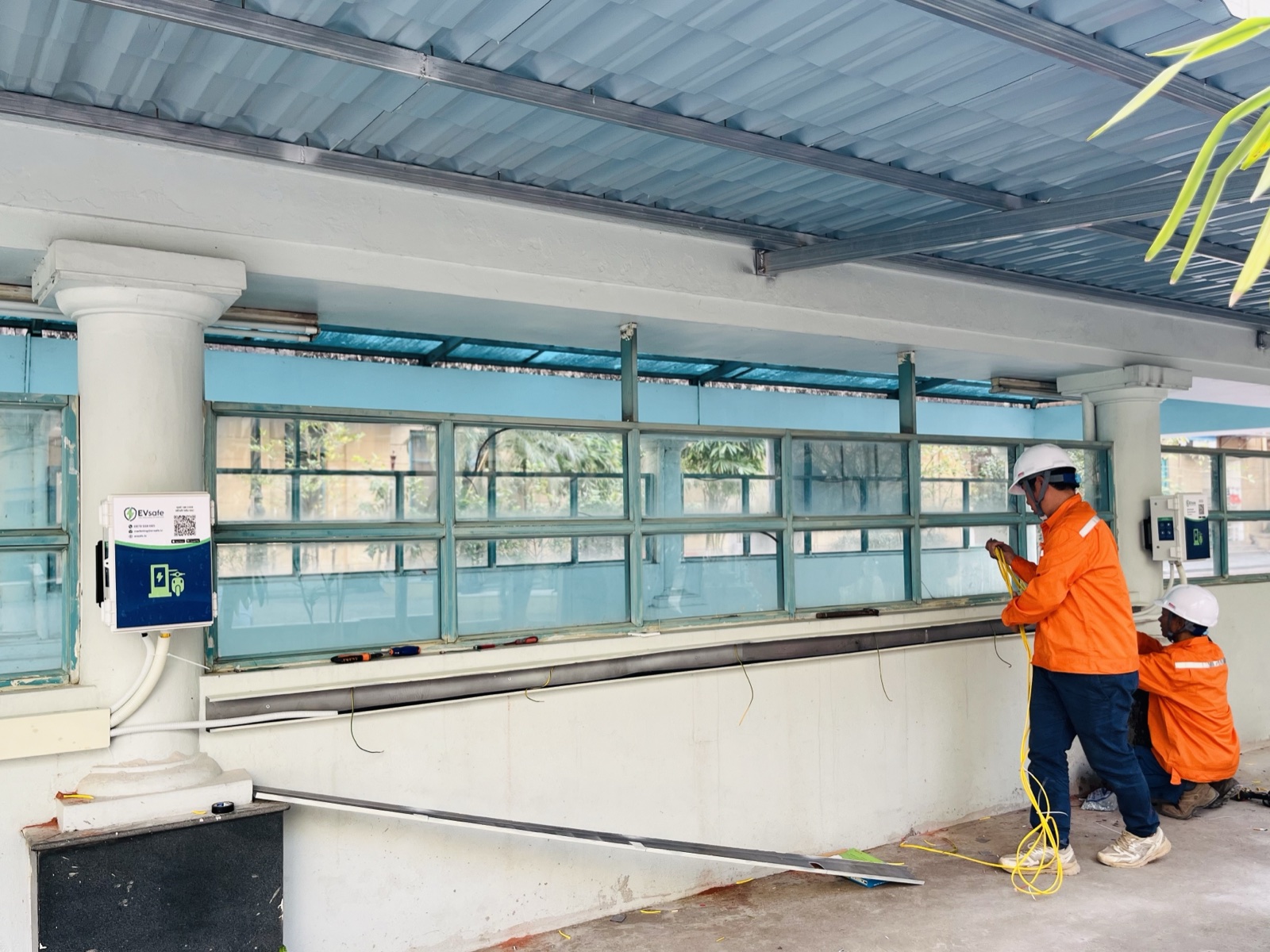
Central electrical cabinet + 3-layer protection
Line labeling, CB/RCBO, grounding, tidy wire routing
Status
Operating
Handover documents
Acceptance record + safety measurement testing
Access by Real Needs
Do you care about “charging technology” or the “site problem”? Pick one path - scroll down to the part you need.
1. By Equipment Type
Motorbikes, cars, battery swapping… each type has different power & risks → different designs.
2. By Site Type
Apartment buildings, F&B, homes… each has a different “operational pain point” → different solutions.
Choose by Vehicle Type
Each charging type = a different “risk profile.” EVsafe standardizes by capacity, protection, and operation.
Electric Motorbike Charging
Most common. Optimized for mini-apartments, rental housing, cafés, small parking lots.
A good fit for: “quick money” + low cost
Electric Car Charging
AC 7-22kW. Requires a load survey & strict electrical-cabinet standards (3-phase preferred).
Good fit for: apartment buildings/offices with car-owning residents
Battery Swap Station
Centralized hub - speed like refueling. Optimized for fleets/high-traffic spots.
Good fit for: operating fleets / extremely high demand
Not sure which type fits? EVsafe will confirm with load survey + ROI on-site.
Solutions By Infrastructure
Not “install the post and you're done.” Each location has its own set of risks: electrical load, aesthetics, charger-user control, fire safety.
Apartment Building / Building
Large scale
Risk: fire spreading in the basement parking, main power overload, strangers charging “for free,” the management board getting blamed if an incident occurs.
EVsafe: centralized electrical cabinet (dedicated fire safety), load sharing by hour, resident/guest permissions, transparent kWh logs.
F&B / Stores
Service
Risk: unsightly wiring, customers tripping, taking up parking spaces, the owner pestered with “how do I charge?”
EVsafe: slim posts + concealed/ceiling wiring, QR self-payment, quota/charging-hour rules to avoid disrupting the shop's operation.
Private Homes / Mini-apartments
Individual
Risk: household electrical overload, overnight charging unattended, thin wires → heat → short circuit.
EVsafe: dedicated separate line + anti-shock, warning stickers/procedures, heat - leakage monitoring, auto-cutoff on anomalies.
Want to choose the right model? Confirm with load survey + risk + ROI on site.
Tip: Below, connect to “Solution Core Logic” to quell fears + lock in trust.
Why EVsafe Is Firm NO Standalone Equipment Sales?
A charging station is high-capacity electrical infrastructure. The risk lies not in the “charging post,” but in wrong wiring - wrong load distribution - operation without monitoring.
“If you just want to buy equipment and install it yourself: EVsafe is not a fit. If you want a partner lifetime responsibility: talk to us.”
Selling “responsibility,” not “stuff”
EVsafe bears the SLA, maintenance, incident logs, kWh reports & handover documents - so you don't bear the legal risk.
Monitoring & prevention
Don't wait for a “fire” to act. The system warns early: overheating, overload, leakage current, disconnection.
How does EVsafe handle risk?
Network loss / Power loss?
Yes Offline mode. Charging data is stored locally and re-synced when the network returns. Revenue doesn't “vanish,” logs remain.
Overloading the building's power?
Load balancing automatically reduces power during peak hours, keeping the main circuit breaker stable - no “tripping the power” for the whole building.
Abnormal heat / leakage current?
Auto cut-off by threshold + instant alert. Goal: cut off before it becomes an incident.
Suggestion: after this section, move on to “SLA / standards” to seal trust.
Cash-flow Mechanism
Transparent - automatic - with reconciliation periods.
Investment
Homeowner or EVsafe (0Đ)
Collect payment from customers
App/QR - 100% automatic
Reconciliation & fund transfer
The 15th & 30th of each month
Revenue share rate
* A technician will advise the most profitable model on site.
Questions About Deployment
The questions investors & property owners ask most - answered directly, no beating around the bush.
What are the minimum conditions to install a charging station? +
Can I install a mix of both motorbike and car charging? +
After installation, are there acceptance documents? +
If the partnership ends, how are equipment & data handled? +
- Data: hand over kWh history, revenue, operation logs.
- Equipment: (1) the owner buys it back to self-operate, or (2) EVsafe dismantles/relocates and restores the site.
Is the system picky about any vehicle type? +
• Motorbikes: household socket (VinFast, DatBike, Yadea…)
• Cars: Type 2 standard (the suitable configuration will be surveyed per project).
How long until it can operate & start generating revenue? +
Do I need to hire someone to watch over / collect payments? +
Do you have more in-depth technical questions?
* Faster reply if you send: address, electrical-cabinet photos, estimated vehicles/day.